

Our Initiatives
The Georgetown One Card (GOCard)
Project Overview
The Georgetown One Card (GOCard) is a central part of daily life on campus. Originally launched in 2000 to bring our campus systems together, it currently powers three essential functions:
- Your Campus ID: Official university identification and authentication.
- Meal Plans & Debit Dollars: Meal plans, flexible spending and campus point-of-sale (POS) transactions.
- Campus Security: Building access control and security alarm management.
Why is the GOCard changing?
Parts of our current GOCard system infrastructure are reaching the end of their operational lifespan. Rather than simply patching an older system, Georgetown is taking this opportunity to launch a comprehensive replacement initiative. This upgrade will provide the university community with a more modern, secure and user-friendly experience.
What to Expect: The Future GOCard Experience
This upgrade will transform how our community interacts with campus access, services and security. Future features will include:
- Unified, Tap-and-Go Mobile Access: Effortlessly unlock building doors and residential hall suite doors using your smartphone.
- Streamlined Self-Service Tools: Manage your credentials easily with an intuitive onboarding dashboard and real-time visibility into your access permissions.
- Proactive Notifications: Stay informed with automated alerts regarding system changes, upcoming requirement deadlines, and credential expiration dates.
- Enhanced Campus Safety: Support a safer university environment through automated identity validation and faster incident response capabilities.
Progress to Date
We are moving carefully and strategically to ensure a seamless transition for the entire campus:
- Gathering Campus Input: We kicked off the project by consulting over 60 stakeholders across campus to map out exactly what Georgetown needs from a modern card system.
- Evaluating Options: Following a formal Request for Proposal (RFP) process, we received competitive bids from leading vendors.
- Rigorous Testing: We narrowed the field to top finalists and put them through an intensive “Proof of Concept” phase. This included sandbox and performance testing and stakeholder demonstrations of the proposed solutions.
What’s Next?
We are currently finalizing our vendor selection and moving into detailed project scoping, timeline mapping and contract negotiations.
As we lock in the implementation timeline and define exactly how this will benefit the Georgetown community (including future details on card distributions or system features), we will share regular updates. Stay tuned!
Security Camera Refresh Project
Project Overview
The safety and well-being of our students, faculty, staff and visitors is our top priority. We are committed to maintaining a secure, welcoming environment and keeping our community fully informed about the steps we take to protect it.
Phase One: Exterior Spaces
After a thorough assessment of our campus security systems, we are focusing our immediate efforts on upgrading our exterior camera network to improve visibility and security in our outdoor, public spaces. Subsequent phases will include interior spaces at various locations.
What Is Happening Now?
We have identified outdoor locations across our DC campuses that will benefit from newer technology or additional coverage and are moving forward with upgrades and new installations at these key locations. Simultaneously, UIS teams are laying the digital groundwork to connect these new systems.
Impacts
The project will include replacing cabling and cameras throughout building exteriors. This means workers will be present in outdoor spaces to conduct this work. Contractors will wear clothing clearly indicating their role in this project and will be accompanied by a member of UIS staff at all times.
Only designated personnel within the Office of Public Safety may access camera footage, ensuring all usage aligns with the university’s privacy policy. Georgetown’s current and new cameras do not use facial recognition technology. More information on how Georgetown uses security cameras to safeguard the community may be found on the GUPD website.
More Information
Any questions or concerns should be directed to help@georgetown.edu.
This page will be updated as this project progresses and as we finalize our plans for the next phases.
Network Refresh Project
Project Overview
Starting in the spring of 2026, Georgetown University is undergoing a major network refreshment project across the Hilltop and Capitol Campuses. Georgetown’s enterprise network comprises 72 buildings, 92 townhomes, and various outdoor locations. Replacing network equipment on a regular cycle – approximately every six years ensures that our GU community has high-performance Wi-Fi and internet services. This project will have a significant impact on student experience, which was highlighted recently by Forbes.
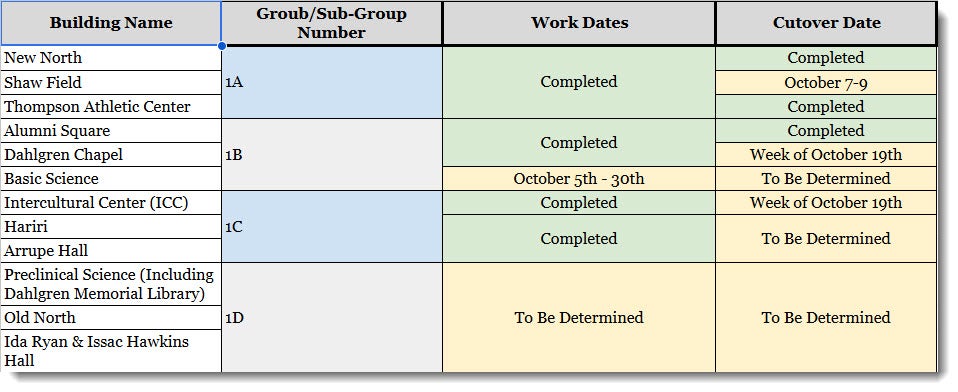
Georgetown University Information Services (UIS), in cooperation with Planning & Facilities Management (PFM), plans to upgrade this infrastructure in six phases (i.e., groups of individual buildings) over the coming years. We will start with a single group of twelve buildings, referred to as “Building Group 1”, which are all located on Hilltop Campus. Work is planned for these buildings in four sub-groups as indicated below:
Timeline
UIS has finalized the schedule for the Group 1 kickoff and completion and is currently finalizing the schedule for Groups 2 and 3. They will communicate this information to impacted building occupants (and on this webpage) as soon as it is available.
Impacts
Cabling Work
The project will include replacing network cabling and wireless access points throughout the buildings. This means workers will need to enter many common-use areas to replace that equipment. Workers may be in these spaces for several hours at a time to ensure the work is completed correctly. Wireless access will not be impacted during cabling work, but there will be building-wide impacts during network cutover dates.
UIS is coordinating access to common spaces with building stakeholders and PFM to minimize disruption to daily routines. Advance notice will be provided to building occupants ahead of impacts. External contractors will wear clothing clearly indicating their role in this project and will be accompanied by a member of UIS staff at all times
Network Cutovers
Each building will have a network cutover after the cabling work is complete. The cutover process will shut down the entire impacted building’s network temporarily, and the goal is to minimize impacts by restoring services as quickly as possible. Smaller buildings will have services restored more quickly; larger buildings will take the better part of a day to restore service. Occupants will be informed in advance of the cutovers so that they can plan accordingly for these network outages.
Questions
Any questions or concerns should be directed to help@georgetown.edu.
Portfolio Management Project
Beginning in summer 2020, UIS (the Office of the CIO) developed a process for submitting, reviewing, tracking, and managing IT projects. The process was developed in order to:
- Promote equity and transparency among our stakeholders by employing the same selection criteria and review procedure across all submissions.
- Ensure agreed upon project outcomes and success criteria.
- Define roles and responsibilities of all involved parties.
- Develop an “intake” process for submitting proposed projects in order to establish requirements (e.g., executive sponsorship, funding, sufficient resources from requester) for successful review of the proposal.
- Properly evaluate and approve projects—determine the impact of projects to the university community and to the university’s computing infrastructure, and whether the proposed project is aligned with university business needs and objectives.
- Develop a method for UIS leadership to set priorities for new work (e.g., “fast track” urgent IT work) and review requests for new work, as well as to communicate this roadmap to stakeholders.
- Track and manage projects, as well as the resources needed for each project, in the IT project portfolio, using an Integrated Master Schedule.
GU360 (Georgetown-Salesforce Partnership)
GU360 is Georgetown’s implementation of the state-of-the-art Salesforce platform, which is the leading Constituent Relationship Management (CRM) system. The goal of GU360 is to build a “connected campus”, providing the campus community with a “360 degree-view” of what’s happening at Georgetown.
The GU360 project is a multi-year effort that has involved partnering closely with many departments and individuals to discuss how GU360 can meet their needs.
GU360 is currently comprised of the following:
- Hoya360 – Student-focused portal that enables students to engage with fellow students, faculty members, deans, academic advisors, and others both within and outside Georgetown.
- GUFaculty360 – Portal for faculty members to create public profiles, upload syllabi for students, share academic work and research with colleagues and complete electronic annual reporting.
- GU360 Advancement is Georgetown University’s central platform for managing relationships with alumni, parents, and supporters. It helps the university coordinate fundraising efforts, process donations securely, and maintain up-to-date records for its global community.
- Marketing Cloud – University-wide email communication platform used to keep Students, Staff and Faculty informed about upcoming events, outages, security alerts and more.
- Community Engagement portal – chronicles the University’s outreach and partnership efforts with many local community organizations, schools, and government agencies
- Research Opportunities for the Center for Research and Scholarship, where students can browse through all available opportunities by Eligibilities
Google Cloud Platform (Georgetown-Google Partnership)
This is a significant strategic partnership between Georgetown and Google that will provide Google technology services to the university. Georgetown is among the first (if not the first) higher education institution to enter into such an agreement with Google, who is new to the higher education environment.
Google provide additional training (GCP, Machine Learning, and Artificial Intelligence), products, services, engineering expertise, and a discount for using GCP (57% discount).
Among the goals of this partnership is to create a state-of-the-art, high-performance computing platform to advance cutting-edge research at Georgetown, enable Georgetown to be an innovator in the adoption of emerging and developing technologies such as machine learning and Artificial Intelligence (AI), and accelerate the university’s move to “the cloud” with such services as Google Cloud Platform (GCP).